ACM Conversational User Interfaces · Bremen, Germany · 21–24 July 2026
How Authoritative Can Synthetic Voices Sound?
Prosodic Manipulation and Perceptual Evaluation Across Two Text-to-Speech Platforms
Hedi Tebourbi1, Anthony Stassart1, Shadi Rastegar2,
Sheetal Vijapurapu2, Anastasia Sergeeva3, Anna Leschanowsky2
1 University of Luxembourg ·
2 Fraunhofer Institute for Integrated Circuits IIS ·
3 SnT, University of Luxembourg
Listeners rated the manipulated Azure voice as significantly
more trustworthy, dominant and confident than its neutral baseline
(all p ≤ .002). For ElevenLabs, the two conditions were
statistically indistinguishable, and both scored high.
These are the 16 voice samples rated in the perceptual study: four financial-advice
scripts, each synthesised by two commercial TTS systems in two prosodic conditions, a neutral default
and a version steered toward authority. All clips use male voices and are loudness-normalised.
Within each row the script and the TTS system are held constant; only the prosodic condition differs.
Headphones are recommended.
Script
Banking
Insurance
Neutral
Manipulated
Median F0 and variability are measured per clip with Praat, using the same settings as the paper
(autocorrelation, floor 75 Hz, ceiling 300 Hz). Variability is the standard deviation of F0 in
semitones. Azure's manipulated voice drops roughly 45 Hz below its neutral baseline and loses about a
third of its pitch variability, which is the manipulation the paper reports. ElevenLabs is already low
and moves little between its two conditions.
The poster
The content of our CUI '26 poster, laid out for reading on a screen.
Research questionTo what extent can commercial TTS systems create voices that are
objectively and subjectively authoritative?
1Background
Voice agents increasingly give recommendations in high-stakes domains such as finance
and healthcare, where the voice itself may carry persuasive cues.
Cialdini's authority principle[1] describes persuasion achieved when
a communicator is perceived as an expert. Authority has measurable vocal correlates: in
human speech it is associated with lower pitch (F0), reduced pitch variability,
and falling intonation[2,3,4].
Yet it is unknown whether commercial Text-to-Speech (TTS) systems can reproduce these
human-like authoritative profiles. We evaluate two systems with contrasting prosodic-control
paradigms, both objectively (acoustics) and subjectively (listening test).
2Defining Authoritativeness
We operationalize authoritativeness as a three-dimensional perceptual construct. These
three dimensions are the attributes that listeners rate in the perceptual study, and
naming them explicitly reduces ambiguity in subjective evaluation:
We wrote 4 textual proposals across two domains, banking (credit cards) and
insurance (policies), 2 per domain. Each was synthesized by two commercial TTS systems
with contrasting prosodic control, in both conditions, using male voices and
loudness-normalized, giving 16 audio samples.
NeutralSystem default, no authority cues. Azure: style none.
ElevenLabs: tag [neutral], Natural stability.
4Objective Study Acoustic analysis of the 16 samples
Method
Acoustic features were extracted from all 16 samples with Parselmouth[8],
a Python interface to Praat[9]: mean F0, F0 variability (semitones),
harmonics-to-noise ratio (HNR), spectral tilt, nPVI[10] over vocalic intervals
via forced alignment[11], and speaking rate.
Each feature is reported as the percentage change from the neutral to the manipulated
condition, so each system is compared against its own baseline.
Baselines differ: GuyNeural ≈ 158 Hz vs. Travis Hill ≈ 107 Hz (already low).
Results
Mean %-change from neutral to manipulated (±SD across 4 proposals). st = semitones.
Feature
Azure
ElevenLabs
F0 mean
−28.7% ±0.3
+2.8% ±7.6
F0 std (st)
−34.7% ±1.9
+2.8% ±18.0
HNR
−5.8% ±2.2
+5.6% ±5.7
Spectral tilt
−9.7% ±3.4
+2.1% ±12.7
nPVI (MFA)
+13.8% ±11.2
−3.1% ±3.4
Speaking rate
−1.6% ±6.1
−1.9% ±3.3
Azure. The unfriendly style lowers pitch substantially and flattens the
intonation contour, pushing both cues beyond the range observed in naturally authoritative
speakers, roughly three times the reduction reported when professionals give expert
advice[2].
ElevenLabs. The authority tags produce negligible, inconsistent and bidirectional
shifts, consistent with stochastic variation rather than controlled manipulation.
5Perceptual Study Listening test with 13 participants
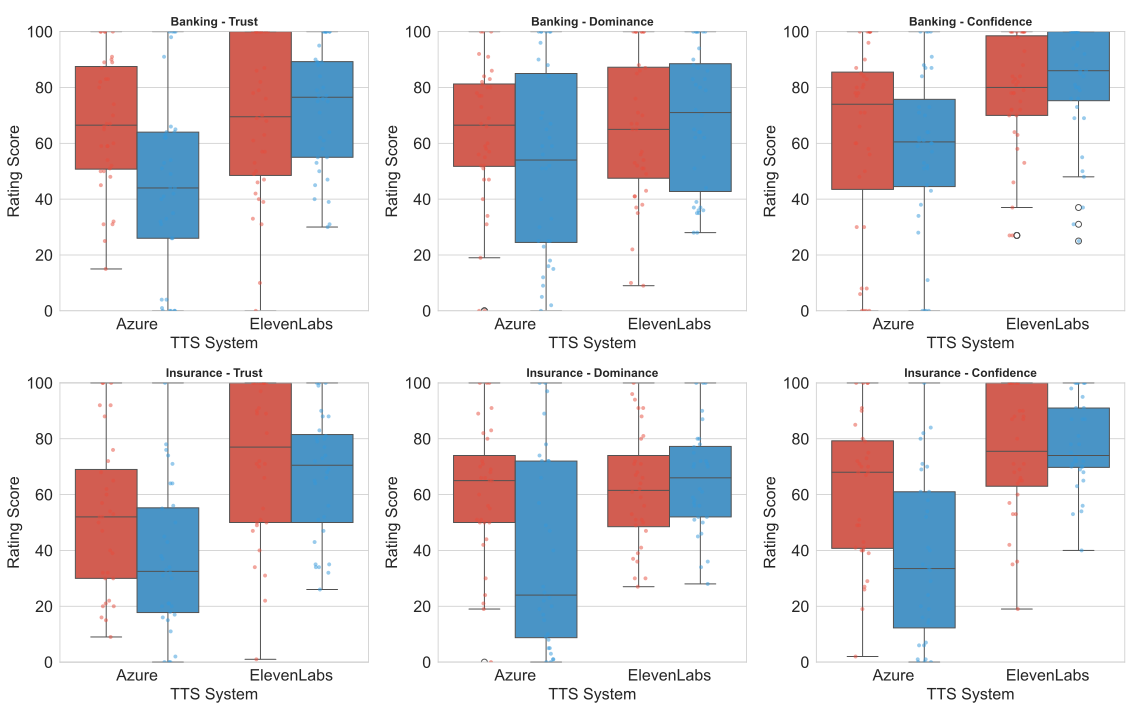
Listeners rated the manipulated Azure voice as significantly more trustworthy, dominant
and confident than its neutral baseline. For ElevenLabs, the manipulated and neutral
conditions were statistically indistinguishable and both scored high.
Method
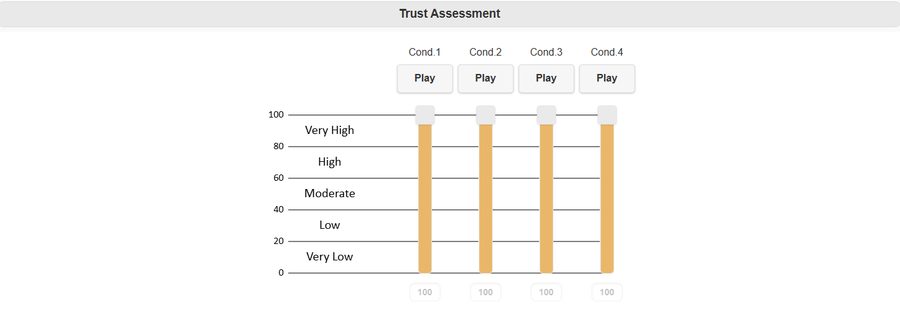
webMUSHRA listening test[12] with 13 participants. For rating,
each of the 16 audio samples is split into two short clips, giving 32 segments
(16 per domain). Every segment is rated on all three attributes (trust, dominance,
confidence) on a 0–100 scale; attributes, samples and conditions were fully randomized.
4 participants completed both domains and 9 completed one, so 17 domain sessions
× 16 segments = 272 item ratings. Each was rated on 3 attributes:
272 × 3 = 816 scale judgments.
One rating page of the listening test. The four versions of a sample
(2 TTS systems × 2 conditions) are played and rated side by side, so both systems can be
compared directly.
Results rating distributions
ManipulatedNeutral
Ratings by domain (rows: banking, insurance) × attribute (columns: trust,
dominance, confidence). Within each panel: TTS system on the x-axis and
condition by colour. The gap between manipulated and neutral opens up for Azure,
while for ElevenLabs the two conditions largely overlap. Tap to enlarge.
Results statistical models
Linear mixed-effects models: effect of the Authoritativeness condition
(manipulated vs. neutral), participant as random effect.
Outcome
B
SE
t
p
Azure
Trust
9.40
3.04
3.09
.002
Dominance
16.22
3.69
4.40
<.001
Confidence
13.46
3.59
3.74
<.001
ElevenLabs
Trust
0.38
3.57
0.11
.915
Dominance
−3.85
2.57
−1.50
.136
Confidence
−3.28
2.37
−1.38
.170
Significant TTS × Authoritativeness interactions on all three outcomes justified
analysing the systems separately.
6Discussion & Conclusion
How you control TTS matters. Parametric prosodic control can inject audible
authority cues; semantic tagging alone may not.
A three-dimensional model (trust, dominance, confidence) offers a reusable basis
for standardized perceptual evaluation of vocal authority.
Azure's shifts are ~3× larger than natural authoritative speech, possibly a
stylised exaggeration rather than a realistic voice.
ElevenLabs' neutral baseline is already low (~107 Hz), inside the
authority-associated range, so both of its conditions scored high.
7Future Work
Extend to female voices, additional TTS systems, and varying semantic content
to separate voice from wording.
Test whether perceived authority translates into real user compliance, not just
higher ratings.
Examine the ethical implications of voices engineered to sound authoritative in
high-stakes advice.
Our 16 synthesized voice samples are publicly released as a basis for future work.
References
Cialdini, R. B. Influence: Science and Practice. Allyn & Bacon, 2008.
Sorokowski, P. et al. Voice of authority: professionals lower their vocal frequencies when giving expert advice. J. Nonverbal Behavior, 2019.
Wang, TY. et al. Effect of manipulated amplitude and frequency of human voice on dominance and persuasiveness. PACM HCI, 2018.
Gomes, D. et al. Acoustics of persuasion: prosodic features on communicative attitudes of confidence. DELTA, 2023.
Mari, A. & Algesheimer, R. The role of trusting beliefs in voice assistants during voice shopping. HICSS, 2021.
Kim, JY. et al. Leadership perceptions, gender, and dominant personality. J. Research in Personality, 2020.
Van Zant, A. & Berger, J. How the voice persuades. J. Personality and Social Psychology, 2020.
Jadoul, Y. et al. Introducing Parselmouth: a Python interface to Praat. J. Phonetics, 2018.
Boersma, P. & Weenink, D. Praat: doing phonetics by computer, 2021.
Grabe, E. & Low, E. L. Durational variability in speech and the rhythm class hypothesis. Lab. Phonology VII, 2002.
McAuliffe, M. et al. Montreal Forced Aligner. Interspeech, 2017.
Schoeffler, M. et al. webMUSHRA: a framework for web-based listening tests. J. Open Research Software, 2018.
Microsoft Azure. Speech Synthesis Markup Language (SSML), 2024.
ElevenLabs. Eleven v3 model and audio tags documentation, 2024.